

Modern businesses generate enormous amounts of data every day. Sales transactions, customer interactions, financial reports, operational metrics, marketing campaigns, and supply chain information all contribute to a growing data ecosystem. While Business Intelligence (BI) platforms help organizations visualize and analyze this information, many businesses still struggle to extract meaningful insights quickly.
Large Language Models (LLMs) are changing the way organizations interact with business data. Instead of manually creating reports, writing SQL queries, or navigating complex dashboards, decision makers can simply ask questions in natural language and receive accurate, contextual, and actionable insights within seconds.
This article explores how Large Language Models enhance Business Intelligence, their benefits, practical applications, implementation strategies, and how EzInsights AI helps enterprises make faster, smarter, and data driven decisions.
Jump to:
What are Large Language Models (LLMs)?
Why Large Language Models Matter for Business Intelligence
Traditional Business Intelligence vs AI Powered Business Intelligence
How LLMs Improve Business Intelligence
Key Benefits of Using LLMs in Business Intelligence
Business Intelligence Workflow Powered by LLMs
Real World Business Intelligence Use Cases
Industry Applications of Large Language Models
Best Practices for Implementing LLMs
What are Large Language Models (LLMs)?
Large Language Models are advanced Artificial Intelligence models trained on massive collections of text, documents, code, and structured information. Using deep learning and transformer architectures, these models understand context, language patterns, and relationships between different pieces of information.
Popular examples include:
- GPT models
- Claude
- Gemini
- Llama
- Mistral
Unlike traditional AI systems that rely on predefined rules, LLMs can:
- Understand human language
- Generate detailed responses
- Summarize information
- Answer complex business questions
- Generate SQL queries
- Analyze documents
- Create reports
- Recommend business actions
When integrated with enterprise data, LLMs become intelligent assistants capable of transforming Business Intelligence workflows.
Why Large Language Models Matter for Business Intelligence
Business leaders need answers, not just dashboards.
Traditional BI tools require users to:
- Learn dashboard interfaces
- Understand KPIs
- Build SQL queries
- Create visualizations
- Filter multiple reports
This process often delays decision making.
LLMs simplify the experience by allowing users to ask questions such as:
- What were our top selling products last quarter?
- Which customers are likely to churn?
- Why did revenue decline this month?
- Compare sales across regions.
- Show inventory trends over the last six months.
Instead of searching across multiple dashboards, executives receive conversational answers supported by charts, summaries, and recommendations.
Traditional Business Intelligence vs AI Powered Business Intelligence
| Traditional Business Intelligence | AI Powered Business Intelligence |
| Static dashboards | Interactive AI conversations |
| Manual SQL queries | Natural language queries |
| Requires technical skills | Easy for every business user |
| Historical reporting | Predictive and prescriptive analytics |
| Manual report generation | Automated report creation |
| Limited contextual understanding | Deep contextual analysis |
| Reactive insights | Proactive recommendations |
| Separate reporting tools | Unified AI assistant |
AI powered Business Intelligence transforms data from static reports into intelligent conversations.
How LLMs Improve Business Intelligence
Natural Language Querying
Users can ask questions in everyday language instead of writing SQL.
Example:
“What were our highest revenue generating products in the last quarter?”
The LLM converts the request into SQL, retrieves the data, and generates visual insights.
Automated Report Generation
Instead of manually preparing monthly reports, LLMs automatically generate:
- Executive summaries
- KPI reports
- Department performance reports
- Financial reports
- Operational dashboards
This significantly reduces reporting time.
Data Summarization
Business reports often contain thousands of rows of information.
LLMs summarize:
- Sales performance
- Customer behavior
- Financial performance
- Inventory status
- Marketing effectiveness
Executives receive concise summaries without reviewing large datasets.
Intelligent Data Exploration
Users can continuously ask follow up questions.
Example:
“What caused the revenue drop?”
Followed by:
“Show affected regions.”
Then:
“What products contributed most?”
The conversation continues naturally without rebuilding reports.
Automated SQL Generation
One of the biggest advantages of LLMs is automatic SQL generation.
Business users simply ask questions.
The AI:
- Understands intent
- Identifies tables
- Creates SQL queries
- Executes them securely
- Returns visualizations
This democratizes access to enterprise data.
Context Aware Analytics
Unlike traditional search, LLMs understand:
- Business terminology
- Customer names
- Product relationships
- Financial concepts
- Industry specific language
This improves both relevance and accuracy.
Predictive Insights
When combined with machine learning models, LLMs can explain:
- Future sales trends
- Customer churn risks
- Revenue forecasts
- Inventory shortages
- Market opportunities
Instead of simply displaying predictions, they explain why those predictions matter.
Key Benefits of Using LLMs in Business Intelligence
Faster Decision Making
Executives receive immediate insights without waiting for analysts.
Improved Productivity
Analysts spend less time building reports and more time solving business problems.
Democratized Data Access
Employees across departments can explore data without technical expertise.
Better Customer Understanding
Analyze customer feedback, surveys, emails, and support tickets using natural language processing.
Reduced Operational Costs
Automating reporting and analytics reduces manual effort while increasing efficiency.
Higher Accuracy
AI minimizes reporting errors and ensures consistent interpretation of business data.
Enhanced Collaboration
Teams can share AI generated reports, insights, and recommendations across the organization.
Business Intelligence Workflow Powered by LLMs
A modern AI powered BI workflow typically follows these steps:
Step 1: Data Collection
Collect data from:
- ERP systems
- CRM platforms
- Finance systems
- Marketing tools
- IoT devices
- Cloud databases
- Excel files
↓
Step 2: Data Integration
Combine structured and unstructured data into a unified platform.
↓
Step 3: AI Processing
The LLM understands the user’s question and retrieves relevant business information.
↓
Step 4: Analytics
Generate:
- SQL queries
- Statistical analysis
- Trend analysis
- KPI calculations
- Forecasts
↓
Step 5: Visualization
Display results using:
- Dashboards
- Charts
- KPI cards
- Tables
- Executive summaries
↓
Step 6: Business Decisions
Leaders take action using AI generated recommendations and real time insights.
Real World Business Intelligence Use Cases
Executive Dashboards
Monitor:
- Revenue
- Profitability
- Growth
- Customer acquisition
- Operational KPIs
Sales Analytics
Analyze:
- Sales performance
- Territory performance
- Product trends
- Conversion rates
- Sales forecasting
Financial Intelligence
Track:
- Cash flow
- Profit margins
- Budget utilization
- Expenses
- Forecast accuracy
Customer Analytics
Understand:
- Customer lifetime value
- Churn risk
- Buying behavior
- Satisfaction trends
- Support performance
Supply Chain Intelligence
Optimize:
- Inventory
- Procurement
- Warehouse operations
- Logistics
- Supplier performance
HR Analytics
Evaluate:
- Employee productivity
- Attrition
- Recruitment
- Performance
- Training effectiveness
Marketing Analytics
Measure:
- Campaign ROI
- Lead generation
- Customer engagement
- Website performance
- Marketing attribution
Industry Applications of Large Language Models
Healthcare
Analyze patient records, clinical data, operational efficiency, and healthcare outcomes.
Banking and Financial Services
Detect fraud, monitor financial performance, automate compliance reporting, and improve customer service.
Manufacturing
Track production efficiency, equipment performance, quality metrics, and predictive maintenance.
Retail
Analyze customer purchasing behavior, optimize inventory, forecast demand, and improve pricing strategies.
Insurance
Evaluate claims, assess risk, analyze policy performance, and automate underwriting insights.
Logistics
Optimize delivery routes, warehouse performance, fleet utilization, and supply chain visibility.
Education
Monitor student performance, institutional operations, enrollment trends, and resource utilization.
Best Practices for Implementing LLMs
Start with High Value Business Problems
Prioritize use cases where AI delivers measurable business impact, such as executive reporting or sales analytics.
Ensure High Quality Data
LLMs perform best with clean, accurate, and well governed data.
Implement Secure Data Access
Protect sensitive information through role based access control, encryption, and authentication.
Use Retrieval Augmented Generation (RAG)
Integrate LLMs with enterprise knowledge bases to provide accurate, context aware responses grounded in your organization’s data.
Continuously Monitor Performance
Evaluate AI outputs regularly, collect user feedback, and refine prompts and data sources to improve accuracy over time.
Train Business Users
Provide training on how to ask effective questions, interpret AI generated insights, and validate critical decisions.
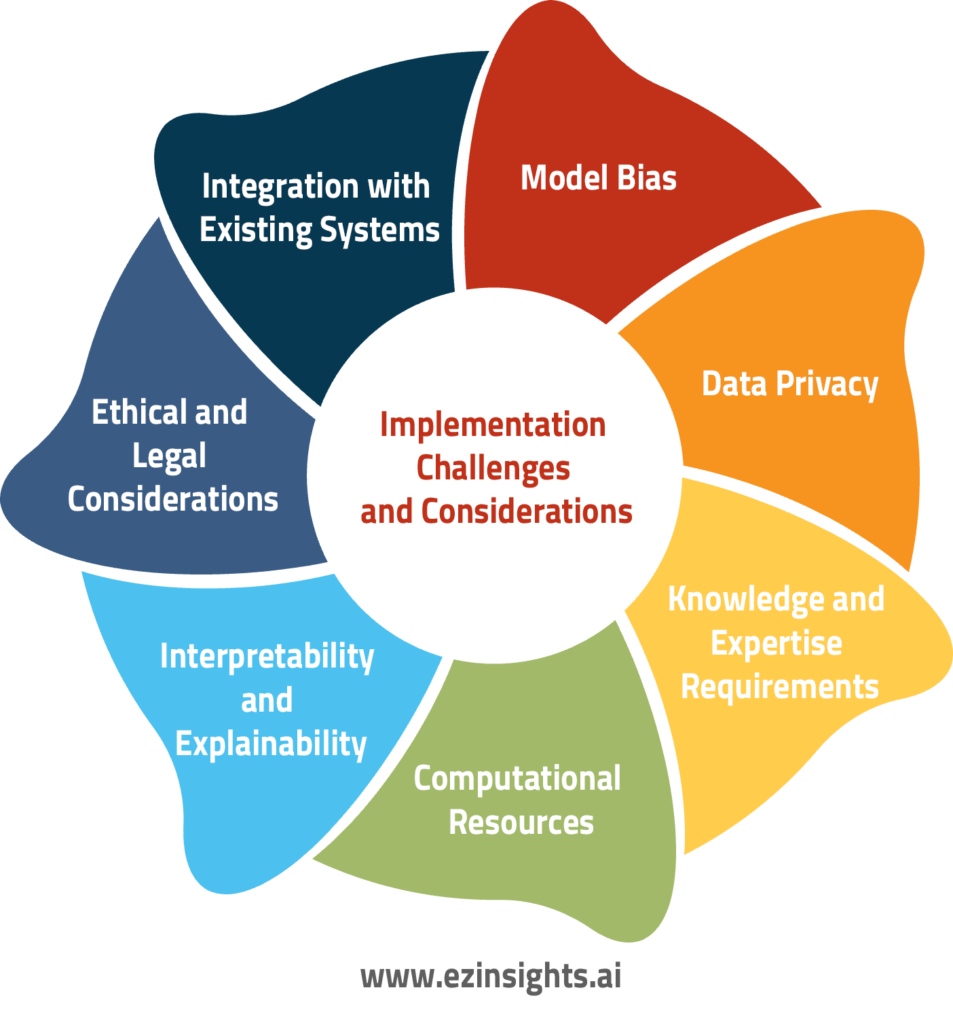
Challenges and Considerations
While LLMs offer significant advantages, organizations should address the following:
Data Privacy
Protect confidential business information using secure infrastructure and access controls.
AI Hallucinations
Ground LLM responses with enterprise data using Retrieval Augmented Generation to reduce incorrect or fabricated answers.
Integration Complexity
Plan integrations with existing BI platforms, databases, APIs, and cloud services to ensure a smooth deployment.
Governance
Establish policies for AI usage, auditing, compliance, and model monitoring.
Cost Management
Optimize model selection, infrastructure, and query frequency to balance performance with operational costs.
Addressing these challenges helps organizations deploy AI responsibly and maximize long term value.
How EzInsights AI Maximizes Business Intelligence
EzInsights AI transforms traditional Business Intelligence into an AI powered decision intelligence platform that enables organizations to interact with data using natural language and receive actionable insights in real time.
Key capabilities include:
- AI powered Text to SQL for querying databases without writing code
- Natural language conversations with enterprise data
- Automated dashboard generation and intelligent visualizations
- Retrieval Augmented Generation (RAG) for accurate, context aware answers
- Executive Command Centers for real time KPI monitoring
- AI generated summaries and business recommendations
- Multi source data integration across ERP, CRM, cloud applications, and databases
- Role based security and enterprise grade governance
- Predictive analytics and trend forecasting
- AI agents that automate reporting, monitoring, and business workflows
With EzInsights AI, business leaders can move from static reporting to intelligent decision making, reducing analysis time while improving the speed and quality of business outcomes.
Conclusion
Large Language Models are redefining Business Intelligence by making enterprise data easier to access, understand, and act upon. Instead of relying on technical expertise and manual reporting, organizations can leverage AI powered conversations, automated analytics, and intelligent recommendations to accelerate decision making.
As businesses continue to generate more data, combining Large Language Models with modern Business Intelligence platforms will become essential for maintaining a competitive advantage. Organizations that adopt AI driven analytics can reduce reporting time, empower every employee with self service insights, improve operational efficiency, and uncover opportunities that traditional reporting methods often miss.
With advanced capabilities such as natural language querying, Text to SQL, Retrieval Augmented Generation, predictive analytics, and intelligent dashboards, EzInsights AI helps enterprises transform raw data into actionable intelligence. By integrating AI into Business Intelligence workflows, organizations can make faster, more informed decisions and build a truly data driven culture that supports long term growth and innovation.
Frequently Asked Questions
What is a Large Language Model in Business Intelligence?
A Large Language Model is an AI system that understands natural language, allowing users to query business data, generate reports, summarize information, and gain insights without writing SQL or navigating complex dashboards.
How do LLMs improve Business Intelligence?
LLMs simplify data access through natural language queries, automate report generation, summarize large datasets, explain trends, and provide recommendations that support faster decision making.
Can LLMs replace traditional Business Intelligence tools?
LLMs enhance rather than replace BI platforms. They provide an intuitive conversational layer over existing dashboards, databases, and analytics systems, making Business Intelligence more accessible and efficient.
What industries benefit from AI powered Business Intelligence?
Industries such as healthcare, finance, retail, manufacturing, logistics, insurance, education, telecommunications, and government can use LLM powered Business Intelligence to improve operational efficiency and strategic decision making.
Is Business Intelligence with LLMs secure?
Yes. Enterprise implementations use encryption, role based access control, audit logging, and Retrieval Augmented Generation (RAG) to ensure secure and accurate access to business data.
What is the role of Text to SQL in Business Intelligence?
Text to SQL enables users to ask business questions in natural language. The AI automatically converts these questions into SQL queries, retrieves the relevant data, and presents the results as reports or visualizations.

Anupama Desai
President & CEO
Anupama has more than 23 years of experience as business leader and as an advocate for improving the life of the business users. Anupama has been very active in bringing business perspective in the technology enabled world. Her passion is to leverage information and data insights for better business performance by empowering people within the organization. Currently, Anupama leads Winnovation to build world class Business Intelligence application platform and her aim is to provide data insights to each and every person within an organization at lowest possible cost.