
Businesses today generate more data than ever before. Every customer interaction, sales transaction, marketing campaign, website visit, and operational process creates valuable information. Yet, for many organizations, this data remains underutilized because traditional analytics tools require significant manual effort to transform raw information into meaningful insights.
Artificial Intelligence (AI) Analytics is changing this landscape. Rather than relying on static reports or historical dashboards, AI analytics continuously analyzes structured and unstructured data, identifies patterns, predicts future outcomes, and recommends the best course of action. This allows organizations to move beyond simply understanding what happened to knowing why it happened, what is likely to happen next, and how to respond effectively.
Whether you are a business executive, data analyst, marketing professional, or operations manager, AI analytics empowers faster decision making, reduces operational costs, and uncovers opportunities that might otherwise remain hidden.
In this comprehensive guide, you’ll learn what AI analytics is, how it works, its key business benefits, real world applications, and how organizations can successfully implement AI-powered analytics to drive sustainable business growth.
What is AI Analytics?
AI analytics is the combination of artificial intelligence, machine learning, natural language processing, and advanced analytics techniques to analyze business data and generate actionable insights automatically.
Unlike traditional business intelligence solutions that primarily focus on historical reporting, AI analytics continuously learns from new data, identifies hidden patterns, predicts future trends, and recommends actions based on business objectives.
For example, instead of simply displaying last month’s sales figures, an AI analytics platform can explain why sales increased or declined, forecast next month’s revenue, identify customers most likely to make repeat purchases, and recommend personalized marketing campaigns to maximize revenue.
Modern AI analytics platforms also enable users to interact with data using natural language. Instead of writing complex SQL queries or creating manual reports, business users can simply ask questions such as:
“Which products generated the highest profit this quarter?”
“Why did customer retention decrease in the western region?”
“Forecast inventory requirements for the next 90 days.”
Within seconds, AI analyzes millions of records and delivers accurate, easy-to-understand answers supported by visual dashboards and recommendations.
Why AI Analytics Matters
The digital economy moves quickly. Business leaders can no longer afford to wait days or weeks for reports before making strategic decisions. Organizations require instant visibility into operations, customer behavior, financial performance, and market trends.
AI analytics addresses this need by transforming massive volumes of business data into real time intelligence. Instead of spending hours collecting spreadsheets, cleaning data, and preparing dashboards, AI automates these repetitive processes and allows employees to focus on solving business problems.
The value of AI analytics extends far beyond faster reporting. It enables organizations to anticipate future demand, reduce operational risks, optimize resources, improve customer experiences, and identify new growth opportunities.
Companies that successfully integrate AI into their analytics strategy often experience improvements in operational efficiency, forecasting accuracy, customer satisfaction, and overall business performance because decisions are driven by data rather than assumptions.
Traditional Analytics vs AI Analytics
Traditional business intelligence has served organizations well for many years, but modern enterprises require more intelligent capabilities. AI analytics extends conventional reporting by adding predictive intelligence, automation, and natural language interaction.
| Traditional Analytics | AI Analytics |
| Reports historical performance | Predicts future outcomes |
| Manual dashboard creation | Automated dashboard generation |
| Requires SQL knowledge | Supports natural language queries |
| Static reports | Real time insights |
| Human driven analysis | AI generated recommendations |
| Reactive decision making | Proactive decision making |
| Limited automation | Intelligent workflow automation |
| Descriptive analytics | Predictive and prescriptive analytics |
This evolution enables organizations to shift from reactive reporting to proactive business management.
How AI Analytics Works
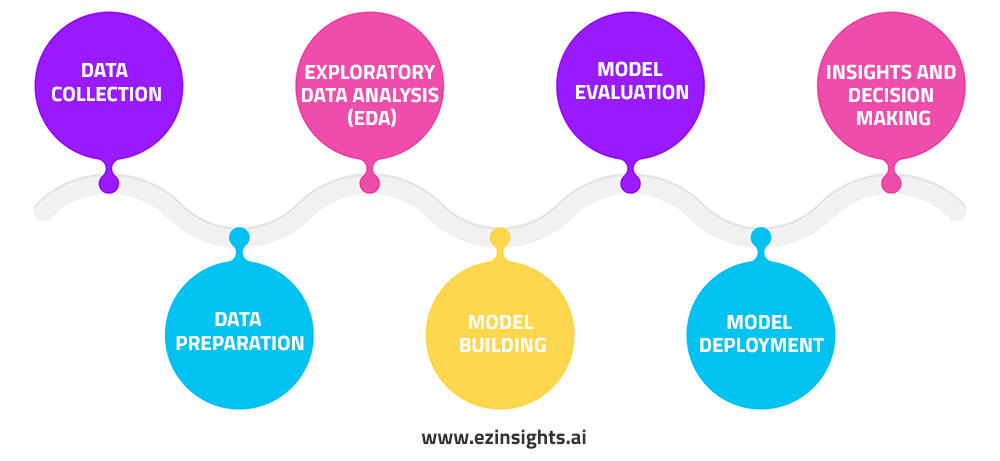
AI analytics follows a structured process that transforms raw business data into actionable intelligence. While the technology behind AI is complex, the overall workflow is straightforward and designed to automate each stage of data analysis.
The process begins by collecting data from multiple business systems such as ERP platforms, CRM software, financial applications, IoT devices, cloud databases, spreadsheets, and external APIs. Because enterprise data often exists in different formats, it must first be standardized and integrated into a centralized repository.
Once the data is collected, AI algorithms clean, organize, and prepare it for analysis. Missing values, duplicate records, and inconsistencies are automatically detected and corrected to improve data quality.
Machine learning models then analyze the prepared data to identify trends, anomalies, relationships, and business patterns. These models continuously improve as new data becomes available, allowing predictions to become increasingly accurate over time.
The insights generated by AI are presented through interactive dashboards, automated reports, and conversational interfaces where users can ask business questions in natural language. Decision makers receive recommendations rather than simply viewing charts and graphs, enabling faster and more confident business decisions.
Key Benefits of AI Analytics
Faster Decision Making
Business leaders often spend significant time waiting for reports from different departments before making strategic decisions. AI analytics reduces this delay by providing real time visibility into business performance.
Executives can monitor key performance indicators continuously and receive instant alerts whenever significant changes occur. This enables organizations to respond quickly to emerging opportunities, market shifts, or operational challenges.
Improved Operational Efficiency
Many business processes involve repetitive manual work, including report generation, data consolidation, and spreadsheet analysis. AI automates these activities, reducing human effort while improving consistency and accuracy.
Teams can redirect their time toward innovation, customer engagement, and strategic planning instead of administrative tasks.
Better Forecasting
Forecasting future demand has traditionally relied on historical averages and human judgment. AI analytics combines historical data with current market conditions, customer behavior, and seasonal trends to generate more accurate forecasts.
Organizations can better plan inventory, staffing, budgets, and production schedules while minimizing waste and reducing operational costs.
Enhanced Customer Experience
Customer expectations continue to evolve rapidly. AI analytics helps businesses understand customer preferences, purchasing behavior, and engagement patterns to deliver personalized experiences across every touchpoint.
From recommending products to optimizing marketing campaigns, AI enables organizations to build stronger customer relationships and increase loyalty.
Reduced Business Risk
AI continuously monitors business operations for unusual patterns that may indicate fraud, compliance issues, cybersecurity threats, or operational failures. Early detection allows organizations to address risks before they become costly problems.
Ten Ways AI Analytics Transforms Business Workflows
- Intelligent Business Reporting
Traditional reporting often requires analysts to spend hours gathering data from multiple systems before creating dashboards. AI automates this entire process by continuously updating reports with live business information.
Decision makers receive accurate, real time insights without waiting for manual report generation.
- Predictive Sales Forecasting
AI analyzes historical sales, customer behavior, seasonal demand, pricing strategies, and market conditions to forecast future revenue with greater accuracy.
Sales teams can proactively adjust strategies instead of reacting after performance declines.
- Personalized Marketing Campaigns
AI analytics enables marketing teams to understand customer preferences at an individual level. By analyzing browsing behavior, purchase history, demographics, and engagement data, businesses can deliver personalized campaigns that significantly improve conversion rates.
Instead of sending the same message to every customer, AI recommends the right content, product, and timing for each audience segment.
- Customer Churn Prediction
Retaining existing customers is often more cost effective than acquiring new ones. AI identifies customers showing signs of disengagement and recommends targeted retention strategies before they leave.
This allows businesses to reduce churn while improving customer lifetime value.
- Supply Chain Optimization
AI continuously monitors inventory levels, supplier performance, transportation schedules, and customer demand to optimize supply chain operations.
Organizations reduce stock shortages, lower inventory costs, and improve delivery performance.
- Predictive Maintenance
Manufacturing companies use AI analytics to analyze sensor data from equipment and machinery. The system predicts potential failures before they occur, allowing maintenance teams to schedule repairs proactively.
This reduces downtime, extends equipment life, and lowers maintenance costs.
- Financial Intelligence
Finance teams use AI analytics to monitor cash flow, forecast revenue, identify unusual transactions, and automate financial reporting.
Executives gain deeper visibility into financial health while improving budgeting accuracy.
- Human Resources Analytics
HR departments analyze recruitment data, employee performance, engagement surveys, and workforce trends using AI.
Organizations can identify skill gaps, improve employee retention, and optimize workforce planning.
- Executive Decision Intelligence
Modern executives require concise business insights rather than overwhelming dashboards.
AI summarizes complex business information into clear recommendations, helping leadership teams make faster strategic decisions supported by reliable data.
- Enterprise Knowledge Discovery
Many organizations struggle to find information scattered across documents, emails, databases, and business applications.
AI-powered enterprise search and knowledge assistants allow employees to retrieve relevant information instantly using natural language, improving productivity across departments.
AI Analytics Workflow
A successful AI analytics implementation follows a structured workflow that ensures business data is transformed into meaningful insights.
The journey begins with collecting data from multiple enterprise systems, including CRM platforms, ERP software, cloud applications, spreadsheets, IoT devices, APIs, and external databases. Once collected, the data undergoes cleansing and preprocessing to eliminate inconsistencies and improve quality.
After preparation, machine learning models analyze historical and real time information to identify patterns, detect anomalies, and generate predictions. These insights are then visualized through dashboards, interactive reports, and AI-powered conversational interfaces.
Finally, organizations use these insights to make informed decisions, automate workflows, monitor business performance, and continuously improve AI models based on new information.
Industry Applications of AI Analytics
AI analytics has become an essential capability across industries because every organization depends on accurate, timely insights.
Healthcare providers use AI to improve patient outcomes, predict hospital resource requirements, and optimize clinical operations. Retail businesses leverage AI to forecast demand, personalize shopping experiences, and optimize inventory management. Manufacturers implement predictive maintenance to reduce equipment failures and improve production efficiency.
Financial institutions rely on AI analytics for fraud detection, credit risk assessment, and regulatory compliance. Insurance companies analyze claims data to detect fraud and streamline policy management, while logistics organizations optimize delivery routes, warehouse operations, and fleet performance.
Regardless of industry, AI analytics empowers organizations to improve efficiency, reduce costs, and make smarter business decisions.
How EzInsights AI Accelerates Enterprise Analytics
Modern enterprises require more than dashboards—they need intelligent systems that convert complex data into business outcomes. EzInsights AI is designed to bridge this gap by combining AI-powered analytics, natural language interaction, and enterprise automation into a unified platform.
With EzInsights AI, business users can ask questions in plain English and receive instant insights without writing SQL queries or depending on technical teams. The platform automatically generates dashboards, summarizes key findings, and provides AI-driven recommendations that support faster decision making.
EzInsights AI also integrates advanced capabilities such as Text to SQL, Retrieval Augmented Generation (RAG), Knowledge Graphs, enterprise search, AI agents, and executive dashboards. These features enable organizations to analyze both structured and unstructured data, uncover hidden relationships, and make informed decisions with confidence.
By reducing manual reporting and accelerating access to business intelligence, EzInsights AI helps enterprises improve productivity, optimize operations, and create a truly data-driven culture.
Best Practices for Implementing AI Analytics
Successful AI analytics initiatives begin with clearly defined business objectives rather than technology alone. Organizations should establish measurable KPIs, ensure data quality, and integrate information from all relevant business systems to create a reliable foundation for AI.
Equally important is maintaining strong governance around data security, privacy, and model transparency. AI models should be continuously monitored and refined to ensure they remain accurate as business conditions evolve. Finally, organizations should empower employees through training so they can confidently interpret AI-generated insights and incorporate them into everyday decision making.
Conclusion
AI analytics is no longer just an emerging technology – it has become a strategic business capability that enables organizations to make faster, smarter, and more confident decisions. By combining artificial intelligence, machine learning, predictive analytics, and natural language interaction, businesses can transform raw data into meaningful insights that drive growth and operational excellence.
As organizations continue to embrace digital transformation, AI-powered analytics will play an increasingly important role in improving productivity, enhancing customer experiences, reducing operational costs, and uncovering new business opportunities. Platforms like EzInsights AI empower enterprises to move beyond traditional reporting by delivering intelligent dashboards, automated insights, Text to SQL capabilities, and AI-driven decision support. Businesses that invest in AI analytics today will be better positioned to innovate, compete, and thrive in an increasingly data-driven world.
FAQs
What is AI analytics?
AI analytics combines artificial intelligence, machine learning, and advanced analytics techniques to analyze business data, identify patterns, predict outcomes, and generate actionable recommendations.
How is AI analytics different from traditional business intelligence?
Traditional business intelligence focuses on historical reporting, while AI analytics provides predictive insights, automates analysis, and supports natural language interaction for faster decision making.
Which industries benefit from AI analytics?
Healthcare, retail, manufacturing, finance, insurance, logistics, education, telecommunications, and government organizations all use AI analytics to improve efficiency and business performance.
Can AI analytics work with existing ERP and CRM systems?
Yes. Modern AI analytics platforms integrate with popular enterprise systems such as SAP, Salesforce, Microsoft Dynamics, Oracle, HubSpot, and many cloud databases.
Is AI analytics suitable for small businesses?
Absolutely. Cloud-based AI analytics solutions make advanced analytics accessible to organizations of all sizes, allowing small businesses to automate reporting, improve forecasting, and make data-driven decisions without significant infrastructure investments.

Anupama Desai
President & CEO
Anupama has more than 23 years of experience as business leader and as an advocate for improving the life of the business users. Anupama has been very active in bringing business perspective in the technology enabled world. Her passion is to leverage information and data insights for better business performance by empowering people within the organization. Currently, Anupama leads Winnovation to build world class Business Intelligence application platform and her aim is to provide data insights to each and every person within an organization at lowest possible cost.