
Every enterprise today collects enormous amounts of data. Yet most leaders admit they only use a fraction of it. Studies show that nearly 80 percent of enterprise data remains untapped because it lives outside structured databases.
This unused portion is what experts call unstructured data, the most valuable and yet the most underused business asset in the digital era.
Understanding what unstructured data means and how to use it effectively has become one of the biggest challenges and opportunities for enterprises, as seen in Transforming Financial Services with GenAI Solutions
What Unstructured Data Means
In simple terms, unstructured data means information that does not follow a fixed data model or organized format. Unlike structured data, which fits neatly into tables or databases, unstructured data comes in diverse forms and formats.
Some common unstructured data examples in real life include:
- Customer emails and feedback forms
- Chat transcripts and call recordings
- Research documents, whitepapers, and reports
- Scanned invoices and contracts
- Images, X-rays, and diagnostic records
- Social media posts and product reviews
Unstructured Data: Driving the Next Wave of Digital Transformation
Today’s enterprises are navigating one of the most significant technological shifts in modern times. As the digital landscape grows, unstructured datasets play a central role in shaping this transformation. From enhancing customer experiences to streamlining operations, unstructured data analysis is creating measurable impact across industries.
When applied using the right unstructured data analysis methods, companies can uncover insights structured data alone cannot provide. For instance, businesses can gauge customer sentiment from reviews, forecast market trends from social media chatter, and optimize supply chains by interpreting free-text purchase orders and communications.
Benefits of Unstructured Data Analysis
Below are some of the most impactful benefits of unstructured data analysis, illustrated with real-world examples.
Better Decision Making
Organizations can analyze emails, reports, conversations, and images to reveal hidden trends. Since nearly 85% of enterprise data is unstructured, this broader visibility helps decision makers understand operational patterns.
For example, healthcare teams can analyze clinical notes to identify symptom trends, while retail teams can study reviews to detect product issues early.
Reduced Manual Work
AI systems can automatically extract data from invoices, forms, and handwritten notes, drastically cutting manual processing time. Many enterprises report a 60–70% reduction in repetitive document work using intelligent automation.
For instance, claims teams can automate form reading, and HR teams can automate resume screening.
Higher Accuracy
AI-powered extraction models trained on unstructured datasets can achieve up to 95–98% accuracy, reducing errors caused by fatigue or inconsistent human judgment.
Financial teams can extract contracts accurately, and logistics teams can capture sensor logs precisely, improving operational reliability.
Faster Time to Insight
Unstructured data analysis methods allow millions of documents, chats, or images to be processed in minutes, versus days of manual review.
Ecommerce teams can analyze customer reviews in real-time, while manufacturing units can detect anomalies instantly, enabling faster decision-making.
Competitive Advantage
Organizations leveraging unstructured data analysis often outperform competitors by spotting trends earlier. Studies show teams using advanced analytics gain 25–30% higher operational efficiency compared to those relying solely on structured data.
Challenges You Should Know
While unstructured data analysis offers immense value, organizations must navigate several challenges to achieve reliable and consistent outcomes. Understanding these limitations helps build better systems, set realistic expectations, and adopt the right mitigation strategies when working with unstructured datasets.
Data Privacy & Security
Unstructured data often contains sensitive information such as personal details, IDs, medical notes, or financial content. Protecting this data is challenging because it exists in multiple formats like emails, scanned documents, chats, or voice notes. Any leakage can result in legal or regulatory risks.
With global regulations like GDPR and India’s DPDP Act tightening, enterprises must implement encryption, role-based access, secure storage, and continuous monitoring. Tools for anonymization and redaction are essential for safe handling of unstructured data examples in real life.
Model Hallucinations
AI models may sometimes generate inaccurate or fabricated results, especially when context is unclear or data is incomplete. This issue is known as hallucination and can lead to incorrect summaries, misleading insights, or faulty predictions in unstructured data analysis.
To reduce hallucinations, enterprises rely on advanced unstructured data analysis methods such as RAG pipelines, strict guardrails, grounded retrieval, and domain-specific fine-tuning. Continuous validation ensures outputs remain aligned with reliable internal unstructured datasets.
Domain-Specific Complexity
Unstructured data varies widely across industries. Medical notes, legal documents, engineering reports, and logistics logs each have unique structures and terminology. General-purpose AI models often struggle with these domain nuances.
Training domain-adapted models, adding custom ontologies, and using specialized vocabulary datasets can significantly improve accuracy. Without these adaptations, insights from unstructured datasets may be incomplete or misinterpreted.
Data Quality Issues
Unstructured data examples in real life often contain noise like typos, inconsistent formatting, duplicates, varying writing styles, or low-quality scans. Poor-quality data reduces the performance of NLP and OCR models, leading to extraction errors or incomplete insights.
Preprocessing techniques like OCR correction, noise filtering, text normalization, and metadata enrichment are crucial to improve clarity. Well-structured pipelines ensure higher accuracy and more dependable results in unstructured data analysis.
Integration with Legacy Systems
Many organizations still rely on outdated systems that cannot efficiently handle modern AI workflows. Integrating unstructured datasets with legacy ERPs, CRMs, or document archives is time-consuming and expensive.
API-based connectors, middleware solutions, and cloud-based data lakes help smooth this transition. However, without proper planning, AI initiatives for unstructured data analysis may face delays or limited scalability.
Real-World Use Cases
Unstructured data exists in medical notes, insurance claims, customer reviews, and warehouse logs. Below are unstructured data examples in real life that illustrate its significant impact across industries.
Healthcare: Clinical Notes to Diagnostic Insights
Hospitals often face challenges because crucial details are buried in handwritten notes and lengthy EMR entries. Using unstructured data analysis methods, AI reads these notes to highlight symptoms, track changes in patient conditions, and flag issues like incorrect dosage or missing tests. This reduces oversight and supports doctors during busy shifts.
By analyzing years of clinical text, hospitals identify patients likely to be readmitted or develop complications. AI-generated summaries help doctors quickly understand patient history before rounds. Leveraging unstructured datasets leads to faster decisions, fewer errors, and more consistent treatment plans even in high-pressure environments like emergency rooms.
Insurance: Claims Automation
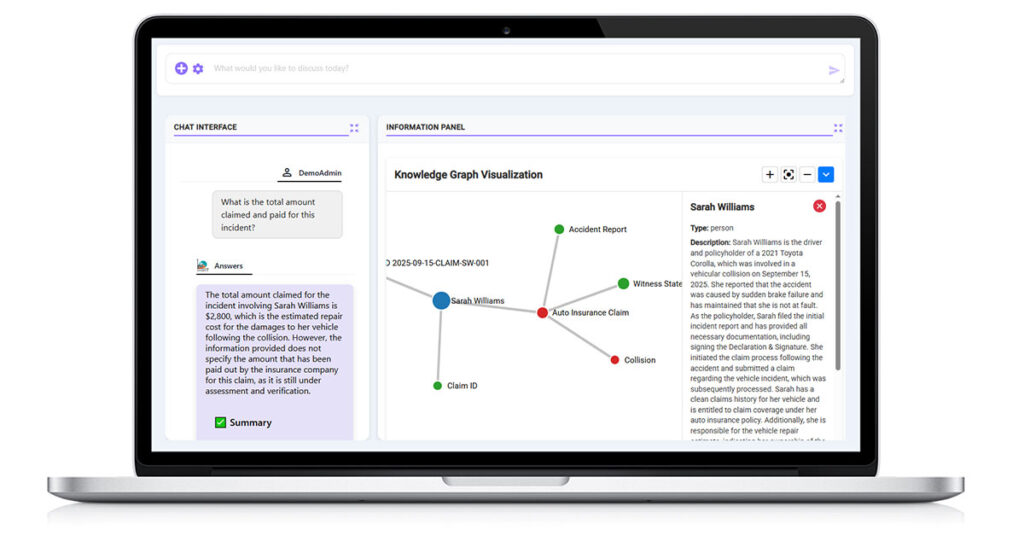
Insurance teams spend hours reviewing PDFs, photos, and handwritten forms. Unstructured data analysis automatically extracts names, damages, accident details, and estimated costs, so assessors do not need to manually read every page. This accelerates claim intake and eliminates delays caused by missing or unclear information.
AI also compares new claims with historical unstructured datasets to detect duplicates, staged accidents, or mismatched reports. Straightforward cases can be approved instantly, while suspicious ones are flagged for human review. This reduces fraud, cuts processing time, and provides faster payouts to customers.
Ecommerce: Understanding Customer Intent
Customers leave valuable insights in reviews, return reasons, support chats, and social media posts. Unstructured data analysis methods help AI spot repeated complaints like “late delivery” or “poor packaging,” guiding brands to fix real issues instead of guessing. It also identifies what customers truly appreciate in top-rated products.
Retailers use sentiment and intent analysis on unstructured datasets to understand buying behavior, such as why customers abandon carts or prefer certain variants.
These insights shape product improvements, marketing strategies, and personalized recommendations, resulting in fewer returns, better product-market fit, and higher customer satisfaction.
Logistics & Supply Chain: Sensor & QC Data
Logistics teams depend on IoT sensors, driver notes, and warehouse camera feeds. AI reads temperature logs, shipment remarks, and GPS trails using unstructured data analysis methods to detect delays, cold-chain breaks, or rough handling. This allows operations teams to respond quickly before products are damaged or deliveries fail.
Warehouse cameras combined with computer vision monitor torn packaging, misplaced pallets, or unsafe worker behavior. These unstructured datasets feed into dashboards that alert managers in real time. Companies reduce spoilage, improve worker safety, and make their supply chains more predictable and dependable.
Building a Strong Foundation for Unstructured Data Analysis
For many companies, diving into unstructured data analysis involves not only adopting new technologies but also a shift in organizational mindset. Assembling a team skilled in unstructured data analysis methods, data management, and practical application is essential for success.
Establishing strong communication channels between analysts and business stakeholders ensures that insights from unstructured datasets and unstructured data examples in real life are clearly understood and effectively applied to strategic decisions. This alignment helps organizations derive actionable value from unstructured content such as emails, reports, images, and social media data.
Implementing a continuous feedback loop further enhances outcomes. By feeding results and lessons learned back into unstructured datasets, organizations can steadily refine the accuracy, relevance, and impact of their unstructured data analysis, improving both decision-making and operational performance over time.
Looking Ahead: The Future of Unstructured Data Analytics
The future of unstructured data analysis is promising, offering organizations advanced tools and unstructured data analysis methods to extract meaningful insights as data volumes continue to grow. Integrating structured and unstructured datasets enables deeper understanding and more comprehensive decision-making.
By investing in the right technologies, fostering a strong data-driven culture, and adopting flexible analytical approaches, organizations can unlock the full potential of unstructured data. These insights can improve operational efficiency, optimize customer experiences, and align analytics with strategic business objectives.
Unstructured data analysis represents a frontier of innovation. Forward-thinking organizations that embrace this shift can transform untapped unstructured datasets into actionable outcomes, gain a competitive edge, and position themselves at the forefront of the digital and data-driven landscape.
Conclusion
Unstructured data analysis is transforming the way organizations operate. By turning raw text, images, audio, and documents into actionable insights, businesses gain deeper visibility, automation, and smarter decision-making.
From healthcare to finance, retail to logistics, every industry can benefit from harnessing the 80% of data that has long gone underutilized.
Enterprises that embrace unstructured data analysis today will shape the competitive landscape of tomorrow. Start unlocking the potential of your data today with EzInsights AI – try it free and experience smarter analytics firsthand.
FAQs
What is the main advantage of unstructured data analysis?
It helps organizations extract insights from data that was previously inaccessible or difficult to process.
Which industries benefit the most?
Healthcare, finance, insurance, ecommerce, manufacturing, logistics, and public sector.
Does AI make unstructured data analysis easier?
Yes – LLMs and NLP models can understand and interpret large volumes of unstructured content efficiently.
What tools are commonly used?
OCR engines, NLP models, LLMs, knowledge graphs, and unstructured data platforms.
Can small businesses use unstructured data analysis?
Absolutely. Even analyzing customer reviews or emails can significantly improve service quality.

Abhishek Sharma
Website Developer and SEO Specialist
Abhishek Sharma is a skilled Website Developer, UI Developer, and SEO Specialist, proficient in managing, designing, and developing websites. He excels in creating visually appealing, user-friendly interfaces while optimizing websites for superior search engine performance and online visibility.